
Companies across various industries depend on reliable, high-quality metal components to keep their operations moving forward.
Yet, one of the greatest challenges they face is finding a trusted manufacturing partner who can deliver custom metal parts that meet their exact performance requirements, production timelines, and cost constraints.
In the following guide, we will walk you through the essentials of metal parts fabrication:
The processes involved, the technologies that make them possible, and the wide range of industries that benefit from these services.
Most importantly, we will highlight how Bunty can help your business overcome some of the most common challenges that come along with custom metal parts fabrication.
Metal parts fabrication encompasses a variety of processes that shape, cut, and join raw materials into finished components.
Each of the methods used in metal parts fabrication plays a unique role in ensuring parts meet the required specifications for strength, performance, and precision.
Let’s take a closer look at some of the key processes modern-day manufacturers utilize to ensure high-quality metal components.
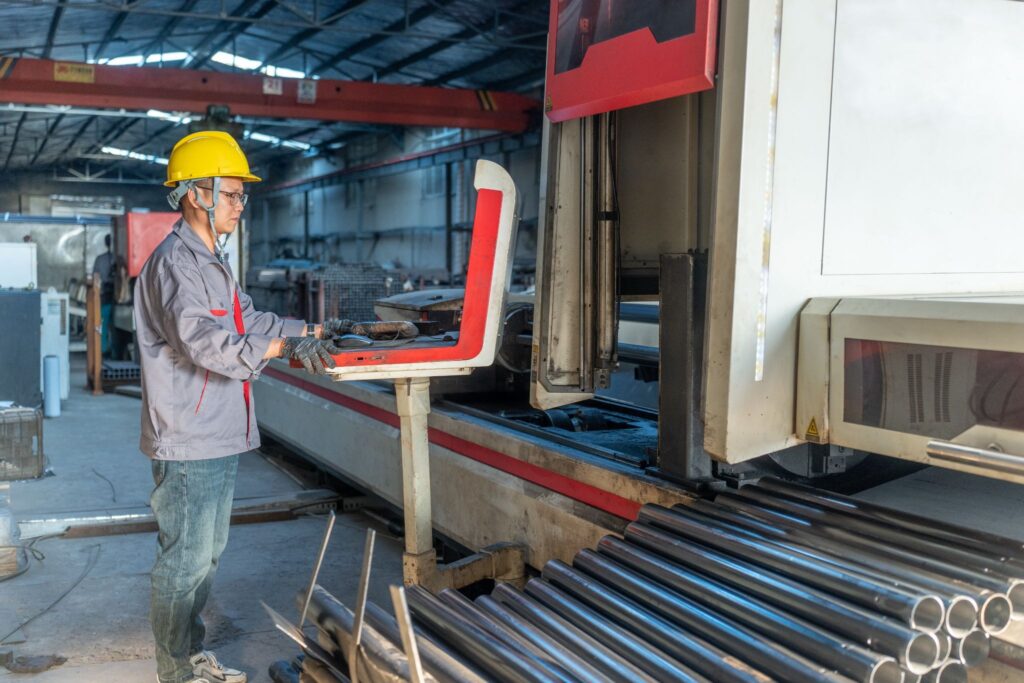
Cutting is often the first step in metal fabrication.
Source: Bunty
Manufacturers separate raw metals into workable shapes and sizes using methods such as sawing, shearing, and laser cutting.
Precision cutting ensures that each piece begins with the correct dimensions to reduce waste and improve efficiency in the later stages of production.
Forging involves shaping metal using compressive force, typically with a hammer or press.
This process strengthens the internal grain structure of the material, producing parts with exceptional durability and resistance to wear, which is ideal for applications that demand reliability under stress.
Casting is the process of pouring molten metal into a mold to form a desired shape.
It allows for the creation of complex geometries and large components that would be difficult or costly to produce through other manufacturing methods.
Forming is used to reshape metal without removing material.
This is typically done by bending, rolling, or pressing it into a specific geometry.
This method is ideal for producing structural components and is essential for industries requiring large volumes of consistent parts.
Machining uses cutting tools to remove material from a workpiece in order to create precise shapes and surfaces.
The process is especially important for applications requiring tight tolerances and fine finishes, such as aerospace components and medical devices.
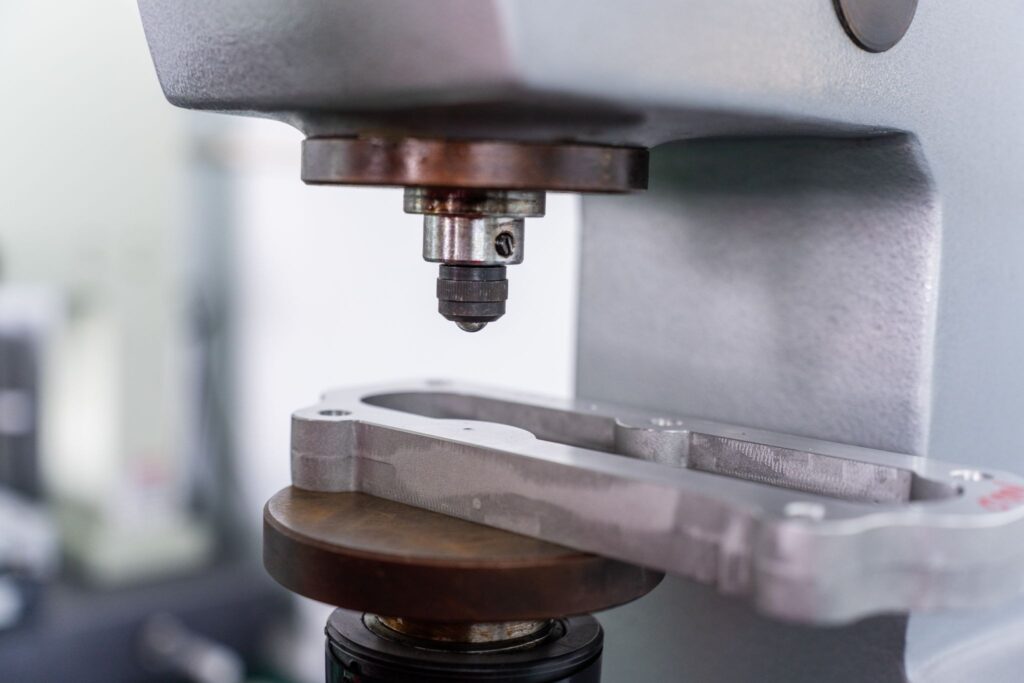
A subset of machining, milling employs rotating cutters to remove material and produce complex shapes, slots, and holes.
Source: Bunty
It provides flexibility in design and is often used for prototyping and custom components.
In the process of extrusion, heated metal is pushed through a die to create long parts with consistent cross-sections
It is highly efficient for producing continuous profiles with excellent mechanical properties.
Stamping uses dies and presses to punch, bend, and emboss sheet metal into a desired form.
This process is a cost-effective method for producing high-volume metal parts and is widely used in automotive and consumer product manufacturing.
Lastly, in welding, two or more joints of metal parts are joined by applying heat or pressure, or both.
Strong, permanent joints are critical for assemblies in construction, heavy machinery, and transportation.
While each of the processes above has its unique strengths, selecting the right combination depends on the material, application, and desired performance.
Advancements in technology have significantly expanded the capabilities of metal parts fabrication.
The manufacturing tools metal manufacturers currently employ not only improve efficiency and precision but also open new possibilities for design and production.
We’ll explore some of the technologies that power modern metal parts fabrication, starting with laser cutting.
In laser cutting, a concentrated beam of light is used to slice through metal with incredible accuracy.
This technology creates smooth, clean edges with minimal waste, making it a highly efficient metal manufacturing option.
Laser cutting is particularly valuable for applications requiring intricate patterns, fine details, or high-speed production.
Computer Numerical Control (CNC) machines automate the cutting, drilling, and milling of metals with unmatched precision.
Through programmed instructions, CNC machining produces complex parts with a consistency that leads to reduced errors and part production repeatability.
CNC Machining is indispensable for industries such as aerospace, automotive, and medical manufacturing that need consistent and reliable metal components.
Unlike subtractive processes, 3D metal printing builds parts layer by layer by referencing digital models (designs).
This approach is ideal for rapid prototyping, customization, and the production of complex geometries that would be nearly impossible to achieve through traditional methods of manufacturing.
This technology also reduces material waste, contributing to cost savings and sustainability.
Computer-Aided Design (CAD) and Computer-Aided Manufacturing (CAM) software serve as the backbone of modern fabrication workflows.
CAD allows engineers to create precise digital models and simulate performance, while CAM converts those designs into machine-ready instructions.
When combined, both software streamline the transition from concept to production, thus improving production accuracy and shortening lead times.
The use of the above advanced technologies for metal parts fabrication not only enhances quality and efficiency but also enables manufacturers to meet the growing demand for customized, complex, and high-performance components.

Metal parts fabrication plays a crucial role in nearly every industrial sector by providing the precision-engineered components that keep equipment, vehicles, and systems performing at their best.
From high-volume production runs to highly specialized custom parts, fabricated metal products form the backbone of modern industry.
For instance, the automotive industry is heavily reliant on metal parts.
From engine components and chassis parts to brackets and body panels, almost every major automotive component contains some form of fabricated metal.
Aerospace applications demand lightweight yet strong metal parts that can withstand extreme conditions.
Fabrication processes like CNC machining, forging, and casting are used to create turbine components, landing gear assemblies, and structural supports that meet the rigorous quality and safety requirements of the aerospace industry.
In the medical field, precision is non-negotiable, and fabricated metal parts are used in surgical tools, diagnostic equipment, implants, and medical devices.
Without properly constructed metal parts, accuracy, cleanliness, and reliability could not be secured for medical components.
The mining industry depends on robust, wear-resistant metal parts for drills, crushers, and transport equipment.
Metal fabrication ensures these components can handle heavy loads, abrasive materials, and challenging environments without failure.
The above industries are all proudly served by Bunty LLC.
Since our founding in the year 2000, Bunty has established itself as one of the most trusted names in custom metal parts fabrication.
With decades of hands-on experience, our team has developed a deep understanding of how to deliver precision, quality, and value in every metal parts project, no matter its size or complexity.
Our experienced and knowledgeable staff work closely with clients to bring each metal parts project from concept to completion.
Whether you require a one-of-a-kind prototype or large-scale production runs, Bunty’s team is equipped to meet exact specifications and performance requirements.
We are capable of producing high-quality, customized metal components.
Every part is engineered to deliver reliability and consistency under the most demanding conditions.
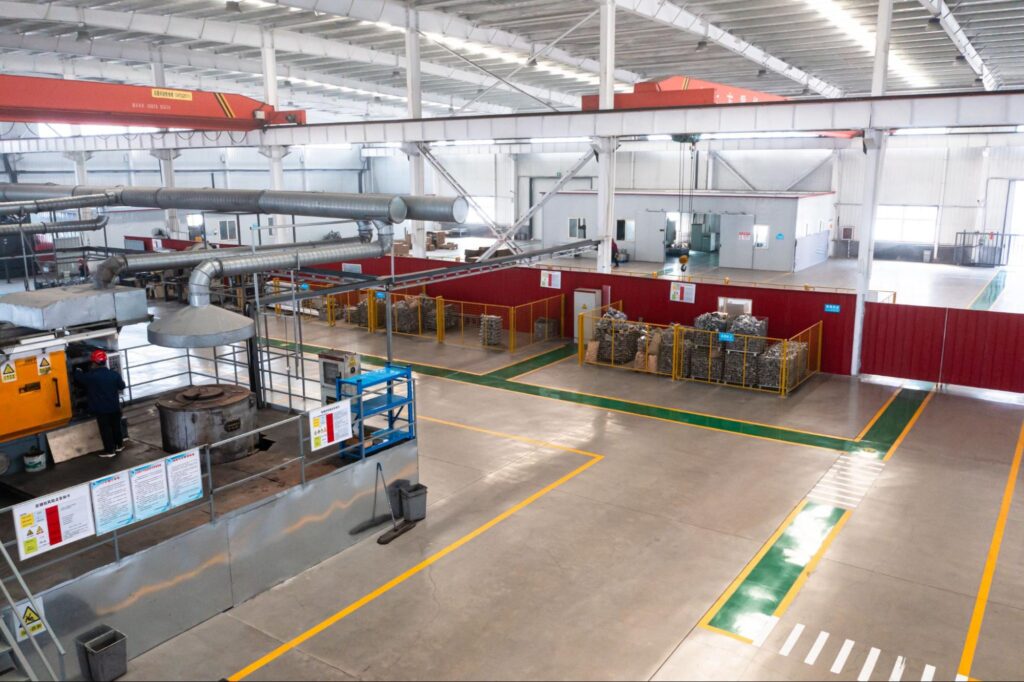
Equipped with state-of-the-art machinery and advanced production capabilities, Bunty can handle even the most challenging fabrication projects with efficiency and precision.
Source: Bunty
With facilities in both the United States and Asia, we can offer fast turnaround times and global manufacturing support with ease.
As an AS9100D, ISO 9001:2015, and CVMSDC-certified company, we are committed to upholding the highest standards of quality management and process control.
Bunty’s certifications reflect the company’s ongoing commitment to excellence, customer satisfaction, and continuous fabrication improvements.
If precision, reliability, and experience matter most to your metal fabrication endeavors, then we are ready to deliver all of that, and more.
Contact BUNTY Today
For more information about metal parts fabrication and our other capabilities, contact us through our website form or request a quote here. We welcome your inquiries.