
Casting is one of the most popular manufacturing processes used to create many different products.
However, casting is not just a single process. It encompasses a multitude of methods each with its unique bent on how to mold, shape, and form metal objects.
With such various means to cast parts and products, it can become quite daunting to determine the most suitable one for each specific application. If the wrong one is selected, problems such as subpar dimensional accuracy, surface finish complications, and even safety hazards may occur.
In the forthcoming sections, we’ll go over three very popular, yet distinct, casting processes and discuss the benefits and applications of each.
So after reading this guide, you’ll get a better understanding of how these different casting methods work and which one would be best suited for your specific metal manufacturing needs.
Sand casting can use nearly any metal to produce parts and products for a wide range of industries including automotive, aerospace, and heavy equipment and machinery.
From aluminum to steel to bronze, sand casting can form almost any type of metal into the desired shape.
Not only can sand casting handle any metal but since sand is used to create the mold, it can form liquid metal into a variety of simple and complex shapes, creating parts of almost any size (grams to tons, millimeters to meters).
When it comes to producing parts with complex shapes, sand casting is one of the best manufacturing options. That’s because molding sand (i.e. sand used in sand casting) can keep its shape no matter how complex the design and won’t fall apart when subjected to high heat.
Sand casting’s ability to mold intricate shapes is so advanced that it often produces detailed and intricate designs that other casting processes struggle to achieve.
This flexibility of design gives sand casting the advantage of being able to manufacture shapes that are difficult or even impossible to achieve with other casting methods.
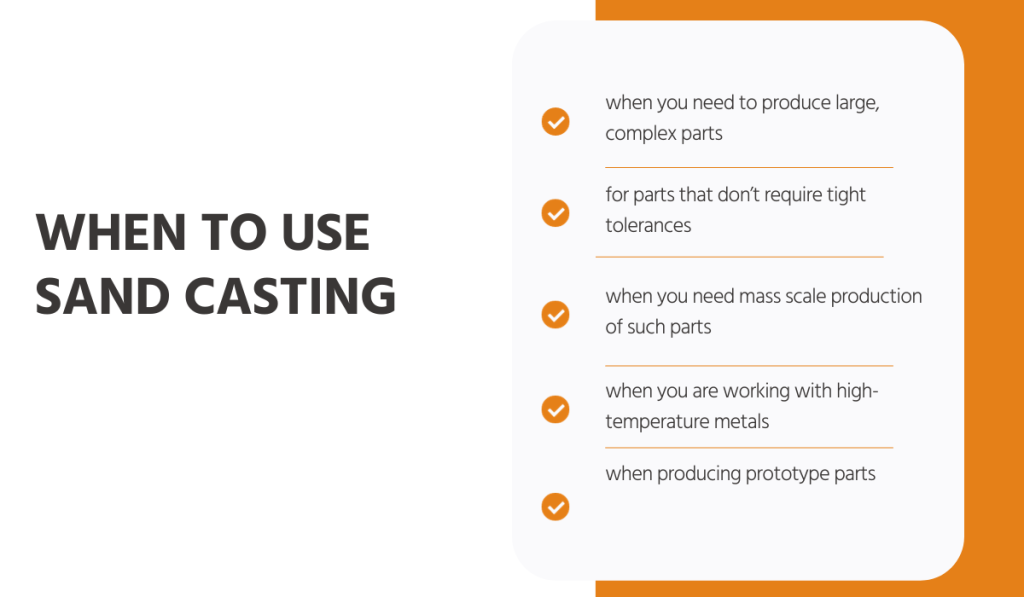
All those features make sand casting ideal for mass-scale production.
The process’s ability to create molds of substantial size allows for the successful casting of larger components.
Industries that require large cast parts for their applications often choose sand casting for this exact reason.
However, sand casting can be used effectively even when the production quantity is low. The low setup costs for this casting method enable small-scale production runs.
Why is sand casting so cost-effective when compared to other manufacturing methods?
First, the equipment investment required for this casting process is minimal when compared to other casting processes. For example, sand, which is the main material used for this process, is relatively inexpensive and can be broken down and reused, reducing tooling expenses to a minimum.
Other raw materials used in sand casting (e.g. binders and risers) are relatively inexpensive as well. Combined with the initial low cost of investment to start the process, this can greatly contribute to a lower overall production cost for casting metal components.
Aside from limited production runs, sand casting is also a good fit for prototype productions where cost-effectiveness and flexibility are crucial factors.
This casting technique also shines when it comes to dealing with metals that have high melting temperatures. That’s because casting sand has a melting point of over 3200 degrees Fahrenheit (1760 degrees Celsius).
Certain metals, such as steel and titanium, require high temperatures to be cast and since sand casting can withstand temperatures above their melting points, it is an excellent choice for working with such metals.
In essence, sand casting offers numerous advantages that make it a go-to option for various manufacturing projects.
Its versatility allows for the casting of nearly any metal. Its low cost, both in terms of equipment investment and raw materials, makes it an economical option for smaller business projects.
And, finally, its ability to scale at various production levels allows for both small batches and mass quantities of simple and complex metal components.
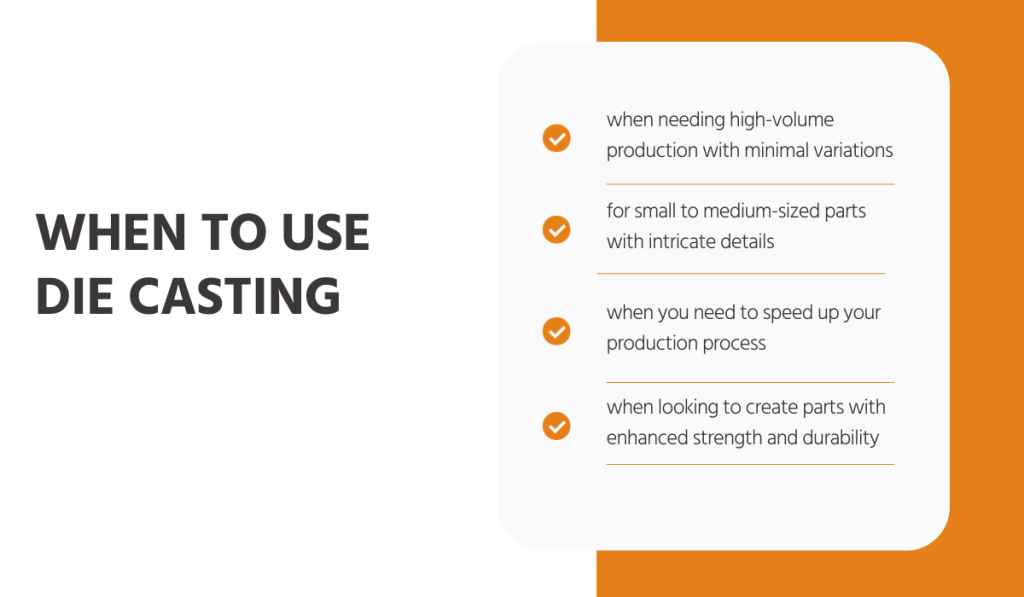
Die casting can and should be used for high-volume production, especially when uniform parts with minimal variation are required.
This process can also be used in the production of low-cost, light metal components that require high precision and strength.
Die casting offers several advantages that other manufacturing processes can not supply, which can guide your decision-making. So let’s explore some of the more prominent ones.
For starters, let’s mention that die casting is an economical manufacturing process.
During die casting, the same die (i.e. mold) can be used repeatedly, allowing for the production of multiple products without the need for constant tooling changes.
Even though die-casting machines, molds, and other equipment related to the process are usually expensive, the process’s ability for mass production spreads these costs throughout the entire production cycle, lowering the long-term expenses through a more even distribution of output.
Reusable molds and effective cost distribution for large production runs are the two key factors that make die casting a more cost-effective option than other methods, especially when it comes to the mass production of cast parts.
But these reusable molds bring another benefit to die casting – speed.
Die casting offers faster production rates when compared to many other casting methods. The ability to rapidly inject molten metal into the die also allows the process to produce parts faster than both sand casting and investment casting since there is no need for the manufacturer to remake the mold each time during the process.
The next thing to mention is die casting’s ability to produce a smooth surface finish. Out of all the different types of casting methods, die casting is perhaps the one that creates the smoothest surface finishes. So if you have such a need, die casting might be the best fit for you.
Find out more about Metal Surface Treatment Services.
Moreover, die casting can also achieve a high level of dimensional accuracy which leads to minimal variations and tighter tolerances of parts.
The die-casting mold design and the injection pressure it uses ensure that the cast product comes out with minimal surface imperfections. Therefore, manufacturers can achieve a lower likelihood of defects for cast parts through die casting.
Aside from the enhanced aesthetics die casting can bring to metal surfaces, its ability to limit surface inconsistencies and deformations also leads to improved properties like corrosion resistance, coating adhesions, and wear resistance.
Metal parts produced through die casting are especially known for their strength and durability.
The use of heat treatment during die casting along with the process’s ability to create compact and rigid structures help increase the overall strength of the cast part.
These enhanced mechanical properties produced by die casting make it an ideal choice for applications where reliability and longevity are crucial. So if you are in an industry that requires metal components with tight tolerances, die casting might be the best choice for you.
Investment casting is a prime candidate for metal manufacturing projects that require complex assemblies or when intricate geometries are involved.
Other one-stage, net-shape processes cannot reproduce complex shapes and fine details to the level that investment casting can provide. This casting process excels in the production of parts with internal cavities, thin walls, or irregular shapes. Traditional manufacturing techniques often struggle to produce such intricate and challenging components.
That’s enabled by this process’s tight tolerances.
Investment casting boasts tight tolerances that can reach as low as .003″, which are even tighter than those reached in other casting methods like die casting.
These tight tolerances and precise fabrication capabilities of investment casting are tailor-made for the production of complex metal components that require multiple moving parts and detailed designs.
When it comes to designs, it’s important to mention that when using investment casting, design engineers and manufacturers have the flexibility to include identifying markers directly into the castings.
Markers such as numbers, logos, and product IDs, can all be stamped into the metal casting through this process.
Including identifying markers within a casting can enhance brand recognition and traceability, which is particularly valuable in industries where product identification and differentiation are required.
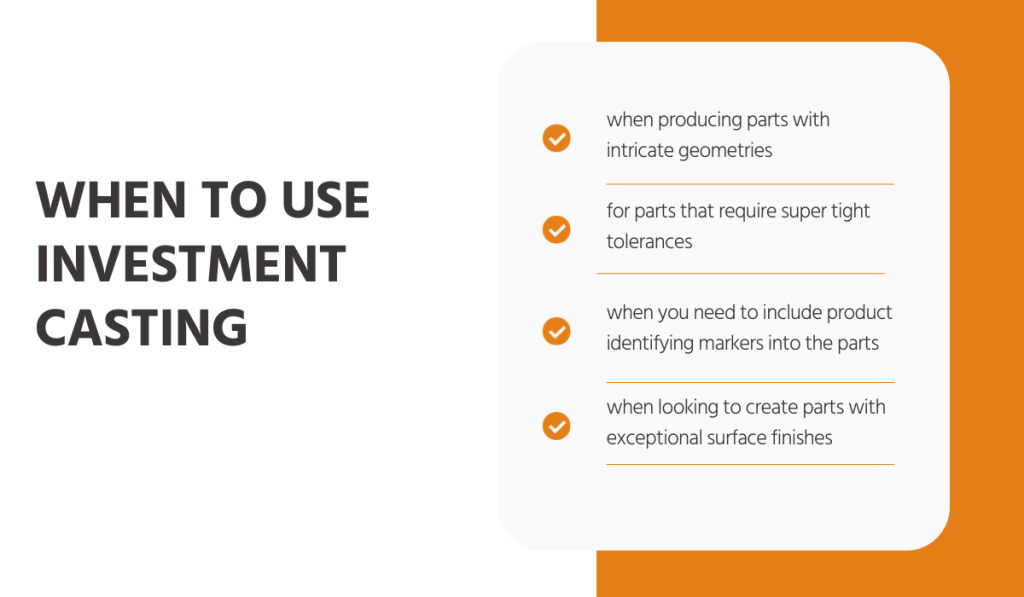
Another notable advantage of investment casting that might be of interest is its ability to achieve superior surface finishes over other manufacturing methods.
Through the lost wax method, parts with exceptional surface finishes that require little to no additional finishing work are created.
Investment casting’s ability to create near-perfect surfaces, via a detailed wax pattern of the final part, not only saves time and effort but also reduces the overall production costs associated with metal casting as no added manufacturing procedures are needed to improve the part’s aesthetics.
And when it comes to cost, know that investment cast parts are relatively more cost-effective when compared to other alternatives for producing complex metal parts.
Investment casting simplifies the production process and reduces both assembly time and costs by consolidating multiple components into a single cast part.
One of the reasons for this cost-effectiveness lies in its utilization of reusable materials. The melted wax used in the process can be reclaimed and remolded for another pattern.
The ability to reuse the wax that is burnt out of the ceramic mold during the process not only cuts material costs but also helps reduce waste, lowering disposal costs as well.
And why should you care about production costs?
Well, reducing metal casting costs can lead to not just higher profitability, but also to more competitive pricing, and sustainability of production, which is good for both metal manufacturers and businesses that need metal parts.
There you have it. We hope this article has given you more insight into the intricacies and differences of each mentioned casting process.
The decision of which casting process to use depends on various factors and considerations.
To sum up, sand casting is well-suited for large, complex parts that do not require tight tolerances, while die casting shines when high-volume production of small to medium-sized parts with intricate details and precise dimensions is required.
Finally, investment casting proves to be the most efficient method and best choice for creating metal components that require complex assemblies and intricate geometries.
Even with this general knowledge, determining the right casting method for your specific needs can still be quite confusing and expensive if the wrong decision is made.
You can narrow down your selection, however, by contacting metal manufacturing experts who guide you through this process.
That way, you will gain a better assessment of your project requirements and be able to choose the most suitable casting method for your particular metal casting applications.