
Metal casting has been used for manufacturing purposes for centuries, as it offers various advantages to metal manufacturers and businesses looking to create metal components for a variety of applications.
Industries such as automotive, aerospace, and construction find the process quite suitable and cost-effective for creating metal parts with complex shapes and intricate designs that are also quite versatile in their scope and efficient in their material use.
In the following article, you’ll find four key advantages this process offers that make it a standout manufacturing method for metal part projects of almost any size and complexity.
Understanding these advantages will not only assist you in making better decisions regarding choosing the right manufacturing process for your project, but also help you optimize resources and maximize material design at the same time.
One of the biggest advantages of metal casting over other methods lies in its ability to create complex shapes using a wide variety of materials and methods.
Namely, the metal casting process offers more design flexibility than machining, welding, and forging, since features such as intricate geometries, thin walls, hollow sections, internal cavities, and fine details are very difficult to achieve through them.
Machining, for example, requires cutting away excess material from a solid block, while welding involves joining separate pieces of metal together.
These extra steps limit the shape and design of the part.
Casting, on the other hand, doesn’t require such added steps, making it a more flexible option for manufacturing purposes.
The casting process is also flexible in its material usage.
It uses a wide range of materials (e.g. steel, iron, aluminum, copper, zinc, titanium, and more), each with its own set of properties.
This allows the use of whichever metal is most suitable for the specific applications and requirements of the client.
In addition to the previously listed benefits, the metal casting process also has the added benefit of being able to employ different methods to shape, mold, and cast different shapes, sizes, and geometric patterns.
The following casting methods are often used to achieve designs and shapes of various complexities:
As design flexibility is an important factor for many industries that need customized and specialized metal parts for their products and systems, metal castings are often chosen for a variety of applications across many sectors.
Some examples of industries that benefit from metal casting’s superior design flexibility features are:
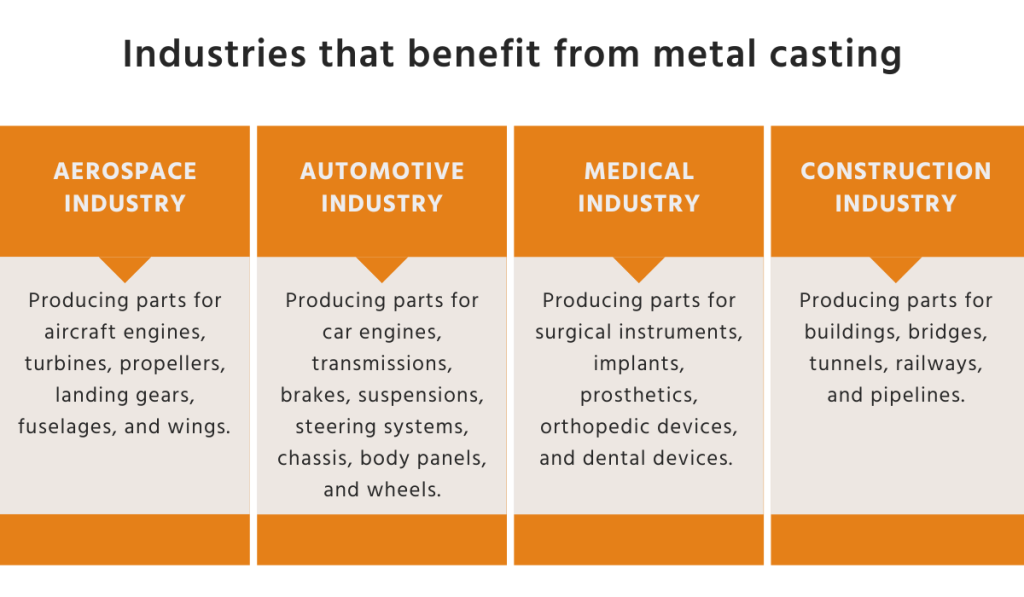
As can be seen from the above, the metal casting process offers a great deal of design flexibility, which allows it to utilize different materials and methods to create metal components of various shapes and sizes.
Metal casting is an extremely cost-effective method for producing low and high-volume metal parts.
Plaster mold casting and no-bake sand casting are two of the two most cost-effective metal casting methods for low-volume production.
As far as larger production runs are concerned, manufacturers are able to use the metal casting process to cut down on costs since they can better optimize the usage of materials through it, especially when demand is high and time is short.
There are multiple factors that make metal casting a more cost-effective approach than other manufacturing methods.
The most prominent ones include high production rates, material efficiency, cost-effective tooling, and material properties.
High Production Rates
Metal casting processes such as investment casting and continuous casting enable high production rates and large-scale manufacturing by minimizing waste, energy, and subsequent machining requirements.
Higher efficiency in production helps meet high demand and reduces unit costs associated with longer production times.
Material Efficiency
Since most casting processes utilize the precise amount of molten metal required for each casting, they can produce near-net-perfect parts without having to rely on other post-casting processes.
The ability to create near-net shape components reduces the need for excessive material removal through machining,
Such efficient material utilization not only results in cost savings but also higher dimensional tolerances and lower-weight components.
Cost-Effective Tooling
Metal casting often involves lower tooling costs than other manufacturing methods.
Once the initial tooling (patterns and molds) is created, it can be used repeatedly to produce multiple castings.
The ability to reuse tools and materials during manufacturing helps reduce the per-unit cost of castings over time, adding to the already cost-effective nature of the process.
Material Properties and Performance
Metal castings offer a variety of exceptional mechanical properties, the most prominent of which are high strength, toughness, and wear resistance.
Increasing mechanical properties in metal components helps optimize performance and reduce the risk of premature component failure and its associated costs.
The ability of the metal casting process to produce complex components with minimal waste and high accuracy makes it one of the most cost-effective manufacturing methods around.
Add to this its capacity to use recycled materials for production and the process becomes even more attractive for industries that rely on low-cost yet durable parts to run their applications.
Aside from saving on costs, metal casting’s material efficiency also produces several other advantages that are extremely desirable for manufacturers and businesses looking for custom metal parts.
These advantages include material conservation, complex geometries, and a broader scope of applications.
Material Conservation
The metal casting process conserves material by utilizing low-cost iron and steel scrap, milling debris, and other materials that would otherwise be discarded.
In addition to this, the metal casting process can also produce finished products in fewer steps than other manufacturing options, thus helping reduce the need for excess material which will ultimately have to be removed through other post-production processes.
Complex Geometries
The ability to produce complex geometries not only helps improve the performance and functionality of cast products but also aids in weight reduction and heat transfer, which saves on both material and energy expenditure.
Wide Range of Adaptations
During the metal casting process, nearly any metal can be used efficiently and effectively to suit the demands of almost any metal parts project.
The process can use lightweight metals such as aluminum and magnesium to reduce the weight of applications.
Alternatively, it can also use high-strength metals such as steel and titanium to increase the durability of applications.
To summarize, the conservation of materials during metal casting helps reduce waste and scrap and produces complex geometries that improve the performance and functionality of cast parts.
On top of all that, it also is able to adapt to a wide range of materials, making it a supremely efficient production method that is well-suited for a variety of applications and systems used in numerous industries.
As was mentioned in the previous section, metal casting can utilize a host of materials to fit various project requirements.
However, the benefits of this versatility offer an additional advantage other than the efficient use of materials.
Metal casting’s ability to utilize various metals gives it more flexibility in producing a wide range of products.
While materials such as epoxy, clay, concrete, and plaster can all be used during casting, it’s the process’s versatile use of metals that sets it apart from other manufacturing methods.
Ferrous metals, non-ferrous metals, and alloys can all be used to form cast components.
Out of all the possible metals available for casting, the types that are used the most include:
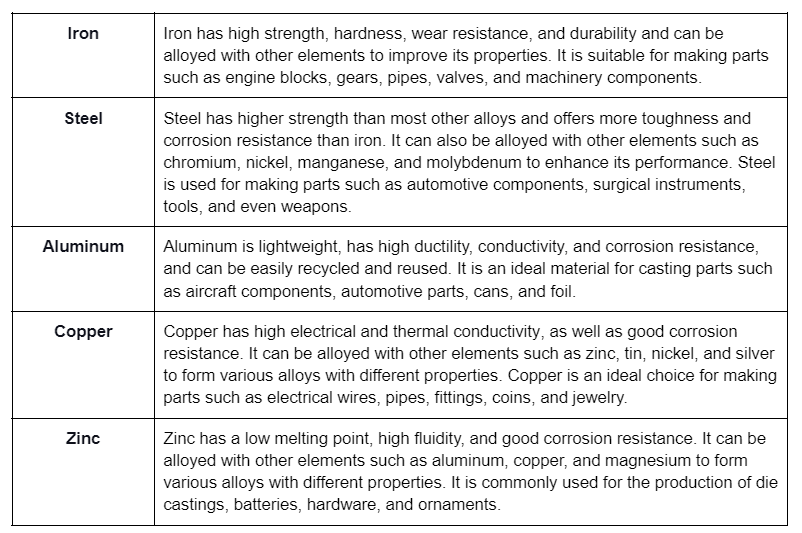
Therefore, it can be said that metal casting is one of the most versatile and cost-effective manufacturing processes that can produce parts out of various metals, which is the main reason why industries that produce a broad range of products choose it for their metal manufacturing needs.
The metal casting process offers many advantages for industries looking to produce metal components for various applications .
Whether you’re looking for parts with complex shapes and sizes, need a manufacturing method that helps reduce material waste and costs, require recycled metals or alloys to create high-quality products with minimal environmental impact, or simply need a manufacturing process that offers a wide range of metals and alloys to create a variety of components, metal casting has got you covered.
That being said, not all metal casting processes are the same and so depending on your project specifications you may need to consider factors such as casting size, shape, weight, tolerance, surface finish, mechanical properties, and production volume before choosing the right metal casting method for your project.
This is why you should consider consulting a manufacturing company that deals with all types of metal casting methods before making any decision regarding metal casting.
With their expert advice, you’ll not only get the right casting method for your project needs but also get additional guidance on important casting factors like design optimization, quality control, and post-processing techniques, if any are required.