
Usually, when people think about infrared ovens, the first thing that comes to mind is a state-of-the-art kitchen oven of the kind usually found in fancy apartments.
However, you shouldn’t be surprised to learn that industrial infrared ovens are even more impressive than their household counterparts.
That’s why, in this article, you’re going to learn all the essential information about industrial IR ovens: what IR ovens are, which types of ovens are available, and how they are used across different industries.
Infrared ovens are a special type of industrial oven, notable for their use of energy waves to deliver heat treatment.
In short, an IR oven releases infrared energy inside the oven chamber to create heat. Since air can’t absorb the energy waves, the processed material absorbs it instead. If there are any water molecules in the materials, they vibrate and create friction and heat.
An industrial IR oven can achieve a temperature of 900°C in less than 10 minutes and cool down just as fast. Besides quick heating times, IR ovens provide consistent heat treatment without causing thermal shocks due to a fast rise in temperature. This is an outstanding advantage for many processing operations. Usually, infrared ovens are powered by gas or electricity.
In fact, the revenue market share of IR ovens is expected to more than double by 2027, compared to 2015. Have a look:
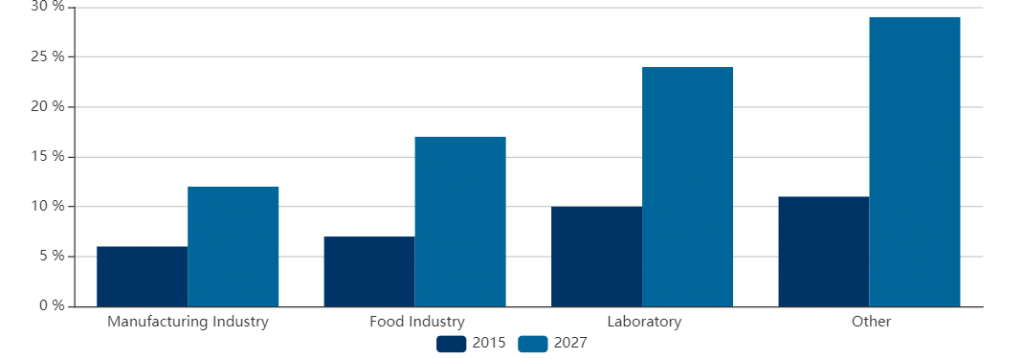
For instance, industrial infrared ovens had a 6% market revenue share in 2015, yet by 2027 that share is projected to top 12%. These are staggering figures.
But how do IR ovens fare next to convection ovens?
Well, convection ovens deliver heat treatment by warming up the air in their oven chamber and circulate it at different angles mid-processing. However, convection ovens take time to heat the chamber and reach the operating temperature. Once thermal treatment is complete, it takes time for the oven chamber to cool down.
On the other hand, IR ovens produce heat regardless of the airflow in the chamber because they concentrate infrared energy. The one thing that matters for successful heat treatment is that the processed materials face the energy source directly. Therefore, IR ovens don’t have to warm up the entire oven chamber. This enables them to reach the operating temperature and later cool down much quicker, saving energy.
Because IR ovens are much more energy-efficient, their operating costs are lower than those of convection ovens, making them the ideal choice for facilities that consume large amounts of energy.
Now that you understand infrared ovens and their operating principles, it’s time to talk about the use cases for industrial IR ovens.
Needless to say, we can use industrial IR ovens in a plethora of ways to complete various stages of material processing. Besides metallurgy, IR ovens are frequently used in plastic processing, as well as the automotive and electrical engineering industries.
Let’s go through the 3 most common uses for this type of oven.
Industrial IR ovens excel at removing moisture from various materials. Unlike convection drying, infrared drying is an indirect drying method. The thermal radiation is transferred from the IR lamp to a lower temperature substrate without the intercession of the airflow within the oven chamber.
Therefore, the energy transfer process is highly efficient and enables much faster drying than traditional convection methods.
Highly productive facilities use industrial IR ovens to cure coatings on various materials.
The prime advantage of IR ovens is that they complete the curing process task faster than convection ovens. Since IR ovens take less time to reach operating temperatures and are quicker to cool down, manufacturers can cure more materials at lower costs.
The second thing to consider is that IR energy is a high-purity heat source, which is terrific for curing. When manufacturers use traditional-style convection ovens, premature hardening of coating surfaces can occur and cause skin-over, blisters, and pinholes on the cured material’s surface.
By contrast, IR energy delivers heat treatment to the material from the inside out, so there’s no risk of poor curing.
These are some materials that can be cured using IR ovens:
Now that we’ve covered curing, let’s move on to the final basic application of IR ovens.
During many manufacturing operations, the materials need to be preheated before further processing. Without proper preheating, you can end up with an uneven coating later on in the production process.
Industrial IR ovens enable manufacturers to fine-tune the temperature needed for the material to be ready. The entire preheating process takes less time with IR ovens compared to convection ovens.
Besides the mentioned processes, manufacturers also use industrial IR ovens for:
As you can see, IR ovens are quite versatile. This is because there are different types of IR ovens that can be used for these purposes.
As with all industrial ovens, IR ovens come in many shapes and sizes and can often complete multiple functions.
The critical feature of IR conveyor ovens is the conveyor belt, which enables materials to move through the oven and undergo heat treatment.
Facility personnel can load and unload materials quickly, which is critical in busy production environments.
IR conveyor ovens serve multiple functions for well-rounded material processing.
For instance, materials go through preheating first, before the belt transports them to a different section of the IR oven and proceeds with curing.
IR shuttle ovens rely on trays (and double trays) for material placement. The materials are automatically loaded in the shuttle and readied for heat treatment.
Shuttle ovens can’t match conveyor ovens in terms of speed and processing volume. However, they are best suited for thermoforming processes, where plastic materials are shaped in a mold.
They’re widely used in many sectors, from the automotive industry to vinyl pressing.
Infrared batch ovens are stationary ovens that treat a batch of materials loaded inside the big oven chamber. Workers access the chamber by opening the chamber door, as opposed to shuttle or conveyor ovens.
They have a large scope of applications that include drying, curing, and preheating.
One additional type of industrial IR ovens worthy of mentioning is the hybrid oven, which relies on the combined technology used in infrared and convection ovens to deliver heat treatment.
What’s unique about hybrid ovens is that they can switch between two types of heating.
There are some significant advantages to using IR/Convection hybrid ovens.
Such ovens:
In short, hybrid ovens allow you to reap the benefits of both technologies, and as such, they find use in various aspects of material processing.
Industrial infrared ovens are quite the engineering wonders, aren’t they?
In today’s environment, manufacturing businesses are constantly looking for new, highly efficient solutions to improve their processing operations.
Since heat processing is often flawed and uneconomical, industrial IR ovens, with their quick heating times and consistent distribution of heat, are a great solution. Thankfully, now that you’ve learned more about infrared ovens, you probably see how they can benefit your business as well.
For further information about infrared ovens and other capabilities, contact us directly via the convenient website form or request a quote here. We welcome your inquiries.